July 12, 2026
Before Tappūtī: The Whole Perfume Trade of Ancient Larsa
Read in another language: Česky · Deutsch · Français · Español
Mesopotamia — Greek for "the land between the rivers" — lies in the fertile band around the Euphrates and Tigris, in what is now Iraq, roughly between Baghdad and the Persian Gulf; it borders the Mediterranean and Caspian seas only indirectly, through present-day Syria and the Iranian plateau respectively. Cities grew up across this region: Ur, Uruk and Babylon in the south, Assur in the north — and Larsa, the southern Mesopotamian city this piece is about. The local economy valued goods in silver, weighed in two units: the shekel (roughly 8 grams) and the mina (60 shekels, about 500 grams). Aromatics and oils themselves were measured by volume, in the qa (roughly one liter) — and it's the ratio of qa to shekel that expresses price throughout what follows. To get a sense of what a single shekel actually meant: a few generations later, around 1800 BC, the laws of nearby Eshnunna set a reference rate of 1 gur (300 qa) of barley per shekel of silver — enough to live on for months. A shekel wasn't small change; it was serious money. And yet no silver was mined anywhere in southern Mesopotamia — the lowlands hold no deposits of precious metal, so it had to be imported, most likely from the Anatolian mines in the Taurus mountains. It functioned as a universal measure of value, even though an ordinary person probably rarely held one in hand. The story below takes place in Larsa under the First Dynasty of Babylon (20th–18th century BC) — several centuries before Tappūtī recorded her formula further north, in Assur.
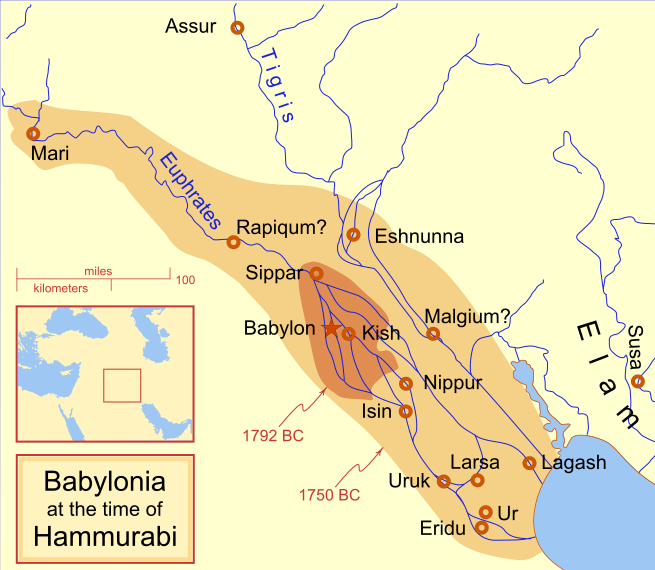
Tappūtī wasn't first. Three centuries before she pressed her formula into clay in Assur, an entire scent economy was already running in Larsa — with merchants, warehouses, price tiers, and a bureaucracy that kept exact records of how many minas of arganum — an aromatic resin whose precise botanical identity has never been established — arrived, who took delivery, and what became of it. The American Assyriologist Robert Middeke-Conlin reconstructed this network from dozens of economic tablets held in the Yale Babylonian Collection and the Louvre in Paris, publishing it as "The Scents of Larsa" in the Cuneiform Digital Library Journal (2014). The result doesn't read like a myth of ancient alchemy — it reads like bookkeeping, because that's exactly what it is.
Three Tiers in One Workshop
Perfume production here was split across three clearly separated roles. Merchants (damgarum) sourced raw materials — sometimes traveling all the way to the source. Officials called šatammu ran the warehouses and decided what went where. Only then did the ì-ra-ra — literally "those who rub the oil" — the perfumers themselves, take over, turning raw material into finished product. This was a division of labor, not a single craftsman's trade running start to finish, from raw ingredient to bottled perfume.
Names from the tablets make the system tangible. Lipit-Irra started out as head of the oil office under King Abī-sarē (r. c. 1905–1895 BC) and, by the fifth year of his successor Sūmû-El's reign, had been promoted to run the perfume workshop itself. Ittī-Sîn-milkī, a supervising merchant from Zarbilum, supplied incense and oils for royal offerings. Watar-Šamaš is recorded as the man who brought in six minas of arganum, one of which officials immediately allotted to oil production. Today they're just names on inventory lines — but at the time, these were people every bit as real as we are: tracking stock, chasing deliveries, watching deadlines. Only the scenery and costumes were different.
Where the Scents Came From
The most expensive materials traveled the farthest. Merchants brought myrrh — šimšeš, and the finer šimsigsig, so-called mukku myrrh — from southern Arabia and India, transshipped through the island of Dilmun, modern Bahrain. From the west, from Syria and Anatolia, came cedar and cypress wood, juniper and boxwood. Apples and figs were grown locally. Susa — capital of the neighboring kingdom of Elam, in the foothills of what is now southwestern Iran — and Eshnunna, a city on the Diyala river northeast of Babylon, functioned as trading hubs where the material changed hands again. One surviving letter has the merchant Šep-Sîn coordinating a purchase in Susa with an escort of royal soldiers — the shipment was valuable enough to warrant armed protection.
Two Methods, No Distillation
Perfumers in Larsa worked with two techniques. Cold maceration — rummukum in Akkadian — meant letting ground aromatics steep in oil at room temperature for days. It took little skill but a lot of time, and produced simpler scents with a flatter profile: one dominant material, little layering. It even turns up in The Curse of Akkad, a Sumerian literary composition (a lament for the destruction of the city of Akkad, likely composed somewhat later but drawing on older material) which, in describing temple furnishings, mentions this exact process in passing: cedar, cypress, juniper and boxwood "ground fine into fragrant oil." That the technique surfaces even in a text with no interest in perfumed oil as such suggests just how ordinary a part of temple operations making it was.
The second technique — repeated steeping in heated water or oil — demanded more skill and produced smaller volumes, but yielded more complex, layered scents. This is the method the tablets refer to with the vague term šim, itself a hint that something more elaborate than simple steeping was involved. At the far end of the scale stood perfumed water: forty washes and a month of steeping, a process so labor-intensive the tablets record it as an exception, not a standard. Distillation — separating aromatic compounds by evaporation and condensation — wasn't used in Mesopotamia in this period; the world would wait centuries more for that.
A Price Scale Almost Anyone Could Afford
What makes Larsa interesting isn't just the luxury at the top, but the spread of prices. A quick note on the numbers: the fewer qa you got for one shekel of silver, the more expensive the oil — little volume for a lot of silver means a high price per liter. According to one surviving tablet, Larsa had at least three price tiers. The most expensive was finished, high-quality perfumed oil (šim) at 3 qa per shekel — a small quantity for a high price. One rung down sat premium, virgin oil (ì-sag) — a high-quality raw material, but not yet a finished perfume — at roughly 5 qa per shekel. And at the bottom of the scale, blended, lower-grade scents (šim ḫi-a) sold at 60 qa per shekel — twenty times more oil for the same silver as the priciest category. Middeke-Conlin concludes that blended perfumes were "much more accessible to the general population" than the tightly specified premium oil. Scent in Larsa wasn't reserved for temple and palace alone; it existed across price tiers reachable by different income groups, and from the reign of King Sîn-iqīšam onward, perfumed oils were even traded independently of temple and palace administration — on the open market, in other words.
What Survived Into Tappūtī's Time
When Tappūtī recorded her formula in Assur three centuries later, she wasn't a pioneer breaking new ground — she was the heir to an already mature tradition, built on trade networks stretching from Dilmun to Anatolia and on an administration that kept exact accounts of how many minas of myrrh went where. The difference between Larsa and Assur isn't that scent was invented twice over — it's a question of who made it into the record by name as the author of a method, and who remained just a line in an inventory list. Larsa has the names of its merchants and officials. The name of a specific perfumer standing behind a specific formula would still take another three hundred years to appear in the Mesopotamian archives.
Series on ancient perfumery: part 0 — Tappūtī, the first recorded perfumer · part 2 — Egypt: kyphi and the expedition to Punt · part 3 — Greece: Delos and Theophrastus
Further reading: the economic data on Larsa and the translations of the tablets cited here draw on Robert Middeke-Conlin, "The Scents of Larsa," Cuneiform Digital Library Journal 2014:1 (freely available at cdli.earth) — currently the most complete reconstruction of the local perfume industry, based on dozens of economic tablets from the Yale Babylonian Collection, the Yale Oriental Series, and the Louvre. The chronology of Abī-sarē's reign follows the standard Middle Chronology of Mesopotamian history. The claim about the absence of precious-metal deposits in southern Mesopotamia and the import of silver from Anatolia follows a survey study on the relative value of gold and silver in antiquity, Cambridge Archaeological Journal. The silver-to-barley exchange rate follows the Laws of Eshnunna (c. 1800 BC), one of the oldest surviving Mesopotamian legal codes.
Try Tapputi Lab
Free perfumery formula software — formulas, accords, inventory, weighing, IFRA compliance and labels, all in one place.
Open Tapputi Lab →More from the blog
Greece: From Palace Tablets to a Perfumery Archaeologists Mistook for an Inn
Ancient Greek perfumery: from Mycenaean tablets through Theophrastus's treatise to the Delos excavations, where a workshop was long taken for an inn.
Egypt: Four Thousand Years of Scent, from the Embalming Workshop to the Expedition to Punt
Ancient Egyptian perfumery: the embalming workshop at Saqqara, the recipe for sacred kyphi incense, and Hatshepsut's expedition to the mysterious land of Punt.
Tapputi: The First Perfumer in Recorded History
Around 1230 BC, a woman named Tappūtī-Bēlet-ekallim recorded a perfume formula that got pressed into clay — the oldest surviving written record naming a chemist. This is what the tablet actually says.